
When I began looking for ways to reconnect with myself, I quickly landed on the idea of values. Maybe you’ve felt it too: that sense that you sort of know what’s important to you, but if someone asked you to name core values, you wouldn’t have a clear answer.
That’s why I decided to start here. For this first step, I’m diving deep into values: what they are, why they matter so much for living in alignment, and how we can uncover them in a way that feels creative and personal. I’ll share the journaling ritual I used to find mine, and hopefully it can spark something for you too ✨.
The Benefits of Knowing Your Values
Values are at the heart of how we show up in the world. They’re the invisible threads that guide our decisions, shape our priorities, and connect us back to who we really are. They are our why. And by naming them, we can create a personal cheat code: a simple way to check whether something feels aligned for us instead of simply doing what we think we “should” do.
Take a moment and remember the last time you had to make a big decision. The uncertainty, the overthinking – maybe you weighed pros and cons several times. Thinking about “the right to do”, rather than trying to find the “right thing for you.” Now imagine making that decision with a handful of clearly identified core values at your fingertips. Suddenly you have a compass: something to lean on and to point you forward. Something to base your decisions and actions on.
- For example, if you value creativity, you might turn down a secure but rigid job in favour of a path that allows you to express yourself. On paper, the first option looks “right.” But following your value compass, you see that the second one will energize you and feel more like home.
- Or if you value honesty, you might choose to have the hard conversation with a friend instead of avoiding conflict. The value doesn’t guide the outcome, but the way you show up.
- And if one of your values is presence, you might put your phone away during dinner and savour the moment, even if “productivity” tells you to stay available and reachable.
Values don’t tell you exactly where to go, but they guide how you walk through the world.
When your actions and choices align with your values, you often feel grounded, energized, and at peace. When they don’t, life can feel unsteady or out of sync, or like it’s not truly yours.
Values aren’t about the what (your goals or tasks) as much as the how. They are the deeper qualities and principles that shape the kind of person you want to be and the life you want to live.
💡 Acceptance and Commitment Therapy (ACT) describes values as “our chosen life directions”, a compass for being and doing in the world.
Your goals are what you achieve; your values are the principles that guide how you get there. Knowing them helps you live with intention and clarity. And that’s the basis for creating a life you love!
Hi there! This is a blog about my journey back home – to myself and my body – through creative expression & tiny rituals. If this sounds like your kinda thing, I’d love to have you on board for my newsletter.
The Journaling Practice
Now that you have a sense of what values are and why they matter, it’s time to discover your own.
Here’s what you need:
- Paper/ a journal
- Pen
- Index cards/ small slips of paper
- Watercolours, brushes and/or coloured pens
- Optional: a cup of tea
The Step-by-Step:
- Set the mood: Pick a quiet space, grab your tea, maybe light a candle. I invite you to turn this into a little ritual. Treat it like an adventure into your own life compass.
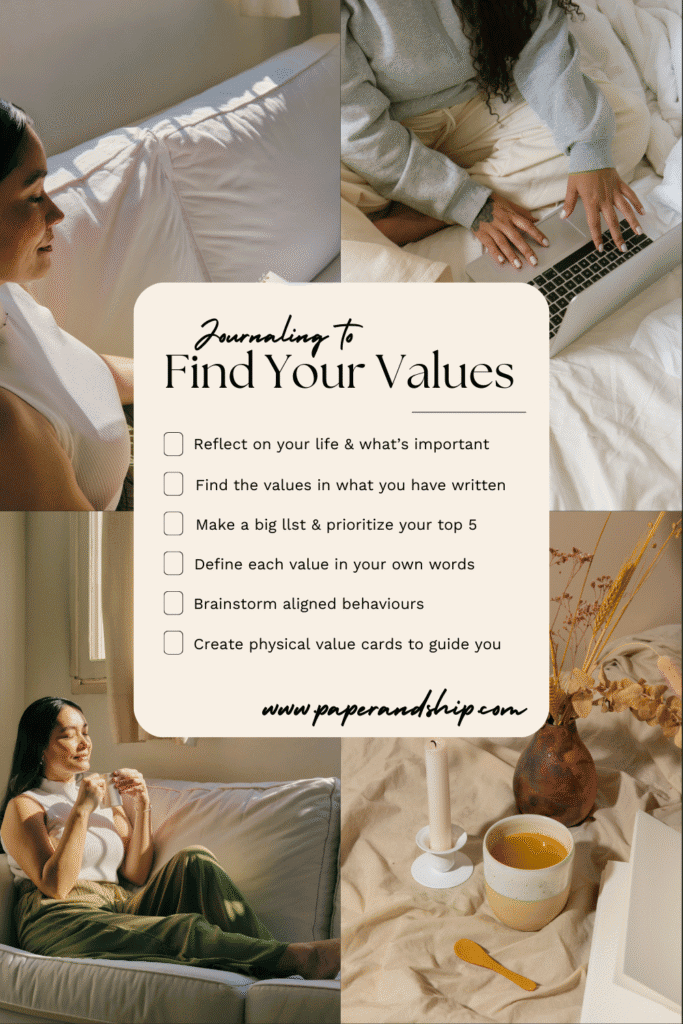
- Journal: Go through the three journaling prompts and write down whatever comes to mind.
- Create a big list of values: Collect the value words from what you have written and fill in the gaps using a values list.
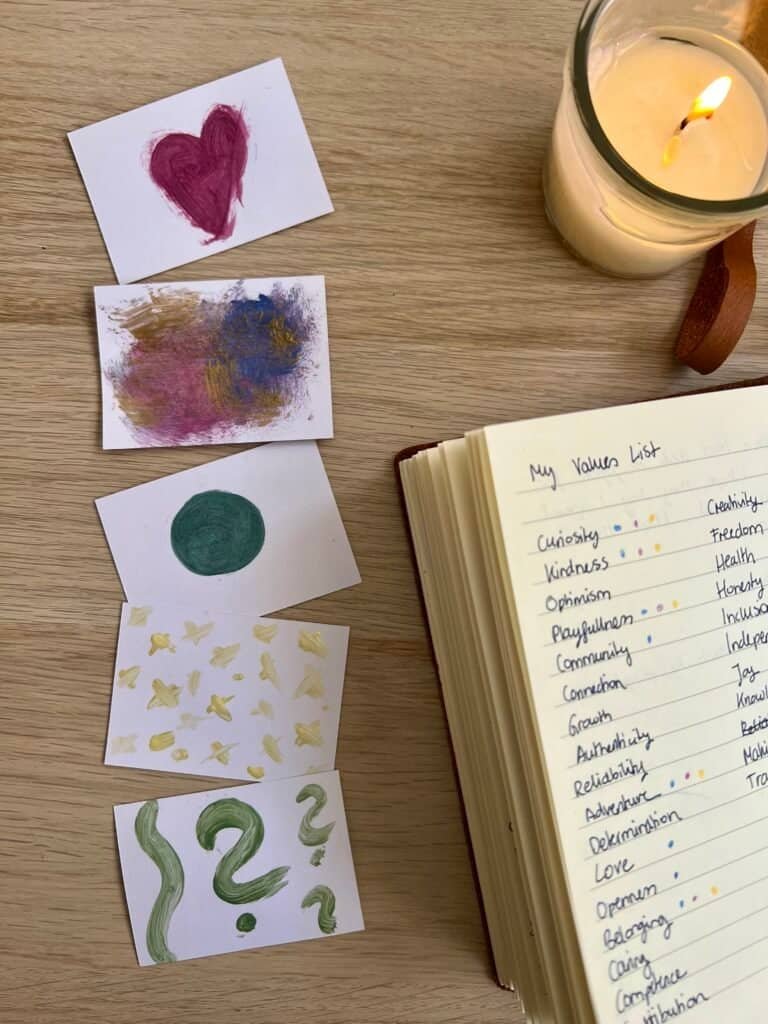
- Pick your top values: Use the coloured-dot system to narrow down your 3–5 core values.
- Create value cards: For each value, write definitions and behaviours on an index card or small piece of paper. Add a drawing or visual representation on the other side.
Journaling Prompts
The goal is to complete the journaling prompts and then surface values from what you have written to create a big list of candidate values. For finding values within your text, scan for repeating words and strong verbs/adjectives. Underline words, circle them or cross them out. Then convert the words and sentences into values (e.g., “I feet safe” → Safety).
1) The Brain Dump
Begin by free writing everything you already know about yourself and your values. What feels important to you in everyday life? What do you care about? The goal is simply to get every idea and association you already have about values out on paper.
2) The 90th Birthday Party
Imagine your 90th birthday. Your friends and family have gathered to celebrate your life. What do you want them to say about you? What moments do you hope they talk about? Free write whatever comes to mind.
A nice way to begin is by starting sentences with “I hope…” and seeing what follows.
3) People You Admire
Think about the people you admire most. What qualities make them special to you? What do you notice in them that you cherish?
The Big List Of Values
Step 1: Gather all candidate values
After you’ve completed your journaling exercises, go over what you have written and compile your values in a big list. To fill in gaps, you can go through a list of value words and add the ones that resonate with you.
Step 2: Select your values
Now that you have a long list of candidate values, it’s time to narrow them down to your core set. As you select the values, the most important thing is to trust your intuition and choose what feels most important to you. If you can’t decide between values, picture a moment when they might conflict. For example: if security and freedom both matter to you, which would you choose if you had to pick? The answer reveals which value is more central when things get tricky.
Grab your pen(s): You can use a single pen, or for a bit more visual flair, grab three coloured pens.
- Give yourself 10 voting dots (or symbols). Place a dot next to the values that feel most important to you. If you’re using colours, this is your first colour.
- Take only the top candidates from Round 1 and give yourself another 7 dots (or symbols), using a second colour if you like, further narrowing your list – essentially eliminating the 3 least important from your top 10.
- Narrow your 7 values down to 3-5 using the final colour or symbol. These will form your core values.
It’s worth noting that while your core values are the 3–5 guiding principles that shape your life overall, it’s also okay to have life-area values: smaller, more specific values that apply to certain parts of your life, like work, friendships, or leisure. For example, Innovation might be a work-specific value, while Play is your value for leisure. The key is not to overthink it: focus first on your core values, and if certain areas of life feel meaningful in different ways, feel free to give them a little extra attention with area-specific values.
Creating Value Cards
Now it’s time to bring your values to life. Grab some index cards and begin by writing one value per card. On one side, jot down all the associations, meanings, and behaviours that come to mind for that value. If you need extra inspiration, feel free to look up the value word online.
On the other side, you have a chance to get creative. Draw symbols, pictures, or anything else that represents the value for you. Let it be playful: this is your personal connection to what matters most.
Here are some prompts to spark inspiration:
- Where do I feel this value in my body?
- What does it feel like?
- What colour do I associate with it?
- When did I last experience this value in my life?
A Daily Values Ritual
Begin your day by randomly picking a card and paying extra attention to that value throughout your day. Over time, these little moments of awareness help bring your values from ideas on a page into living, breathing parts of your life.
💡 In ACT, this is the concept of savouring and flavouring: paying attention to the small, everyday moments where your values can be expressed, and fully enjoying (savouring) the experiences they bring. When using your values cards, pick one card every morning and think about how you can flavour your day with that value through small actions, moments of awareness, or gestures that let that value shine.
Final Thoughts
You did it! You reflected on what’s important to you, collected things that light you up, and created a list of your core values. You now have a compass to guide you towards an intentional, well lived life – one that truly feels like home.
To a journey that feels like yours,
Annika xo

Leave a Reply